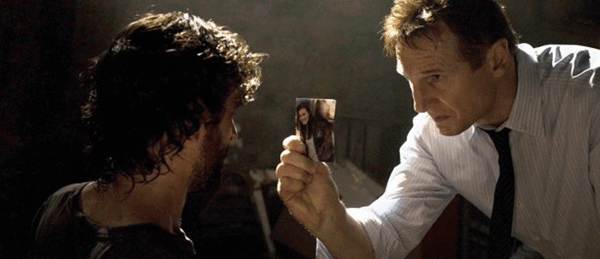
‘Taken’ Stereotyping Bingo!

I have a very particular set of skills. Skills which make it impossible for me to enjoy most Hollywood movies. I don’t regret this, in fact, I actively seek to pass this affliction onto others and even to ‘ruin’ my students ability to simply sit back and enjoy mass media output. My condition stems from years of teaching sociology modules on popular culture. This year, my Cultural Globalisation course has included the ways in which ethnic minority groups are portrayed in the movies and news media texts which are brought to us by Multinational Corporations, most of which are based on North America and controlled by white middle class men.

We have looked at many examples of stereotyping in news media (especially following the terror attacks in Paris last November), in advertising, and in movies. We have discussed how language and sound (including slang, accent, and who gets to speak/how often and aided by background music); imagery (including background, landscape, colours and lighting, style of dress/ facial features, machinery and weapons etc) as well as storyline (including subplots and events during individual scenes) can all contribute to portraying different types of people in different ways. Over and over again, we have noticed how the hero of the movie (you’ll know this person – they are the one who goes through difficulty and comes out winning, the one who starts out in one place and through a struggle, journey or challenge is transformed and ends up somewhere much preferable) tends to be white, Western (usually North American) and male. All other characters serve to impact on this character for better and for worse, and end up one-dimensional, typecast, or presented as the Other.

While most of the Western mass media embrace this kind of stereotyping at one level or another, one movie franchise that does so spectacularly, is the Taken series. It has the added benefit of being ripe with two forms of stereotyping; one based on ethnicity, the other on gender. Albanian, French and Arabic characters are all villains in different ways, and the female characters are simply incapable of making reasonable decisions or taking care of themselves. To demonstrate the issues to students, I have developed a TAKEN IN-CLASS GAME. I have not yet had the time to try it out, but I envisage it as a sort of Bingo game, which might be a fun yet educational way to end a semester. I imagine it would work like this:

Divide the class into two groups. One group is tasked with ‘collecting’ instances of stereotypical depictions of non-white/ non-American characters; the other with identifying examples of sexism or stereotypically gendered portrayals. Students should note down each example, and the group with the most at the end of the movie ‘wins’.

You may wish to adapt the game to suit your needs, and other options include:

1) For a more fast-paced, lively game, students could be rewarded in real time, shouting out ‘racism’ or ‘sexism’ each time they notice either. Although with this movie in particular, I imagine this version could quickly get out of hand…!

2) If the students need a bit of inspiration, you could write key things to look out for on a whiteboard, and either have them note these down as they movie plays, or call them out and you could give each a tick. I like this version, because at the end you would have a visual display of how racist and sexist the movie actually is. The key words could include (these are just examples:

SEXISM RACISM
Damsel in distress Ethnic minority character untrustworthy
Male hero saves the day Ethnic minority character violent
Weak female (physically or mentally) Ethnic minority character dirty/poorly dressed/ at home in hostile environment
Hypersexualised / half-naked female Ethnic minority / non-US character weak/afraid
Female making the wrong decision White US character strong / powerful
Overemotional female White US character skilled, knowledgeable, capable
Male using rational logic White US character heroic / selfless / likeable  …  etc …

To encourage student engagement, certain things (that appear less frequently) could carry extra credit or lead to spot prizes.

I am most familiar with the first movie in the series and the game is based on that one, but from what I have seen of Taken 2, it would work equally well.

I would love to hear from anyone who does similar exercises, or even puts this one into practice. If you do, have fun!


Docklands Walk

Yesterday I spent a wonderful morning with the final year DBS Social Science students who braved the cold winds to come with me on a walk in the Dublin Docklands to discover how globalisation and de-industrialisation have impacted the landscapes and communities of the city.

I’m looking forward to seeing the photos they took for their visual sociology assignment!

docklands

the sounds of the city (well, parts of it, anyway)

Sociology Sounds, the recent initiative by the people over at Sociology Source to identify and recommend songs for use in the sociology classroom seems like an excellent idea. Most of the songs recommended are American or British in origin, and while many of them address aspects of human experience that people in most Western countries can relate to, it got me thinking about music that particularly speaks to the Irish existence. The first song that came to mind was Ghosts of Overdoses by Dublin singer songwriter Damien Dempsey, an artist who writes in a voice that remains true to the working class culture in which he grew up. He is, for me, one of Ireland’s greatest contemporary poets, less bland than Bono and far more accessible than Heaney.

On the surface, Ghosts of Overdoses is a song about drugs and a youth culture based around drug taking. However, listen closer, and it is also a moving and insightful analysis of Irish urban development and the impact it has on the lives of those displaced by gentrification. It gives voice to people who usually appear in journal articles and lecture slides only as graphs and statistics.

Gentrification is a common phenomenon in cities around the world, but here it has been given a particularly Irish slant, tracing the history of Irish urbanisation (with the lack of real industrialisation is was the great famine, along with landlordism, subdivision and rural poverty that pushed people into Dublin). It also makes a direct comparison of life in Tenement Dublin, and in contemporary housing estates, where death by heroin or by tuberculosis are one and the same thing, both tragedies suffered by the powerless.

It is a critical account, blaming ‘those in power’ which resonates with contemporary Irish feelings towards their government. But it is also an insight into the emotional devastation brought by uneven social change, and it speaks for those whose story so often goes untold. The line ‘it’s every parent’s worst fear for their child to end up on smack’ is particularly poignant, even chilling, because – due to those very processes of economic change, urban planning strategies and gentrification that sociology students may learn about in class – in the real world, for some parents that fear is far more immediate and real than for others.

Ghosts of Overdoses can be found on the album Seize the Day, released in 2003 by Clear Records / Sony

visualising urban change

Last month, I taught three lectures on urban change as part of an introductory module for first year social science students. We discussed how global economic processes impact on urban planning decisions, and we considered gentrification, suburbanisation, and the role of both tourism and recession in relation to the development of a city. We ended on a discussion about ways in which city dwellers can redefine their sense of place, and looked at examples such as urban farming, allotments and graffiti. While we focussed mostly on Dublin, we also examined other cities in transition such as Detroit and Havana.

However, the reason I include a post about this module on the blog is that we also considered research methods for documenting, exploring and understanding urban change. You could look at some statistics. Or a map. You could examine policy or literary accounts.

Or, you could use visual methods. Which is what we did.

As part of us working through the ideas covered in class, I asked the students to go on a ‘photowalk’, and take pictures of examples of places where they saw evidence of the processes we had discussed in class. We got some great results, and in the last class we practiced ‘reading’ photographs by using the students’ images as examples.

I think they enjoyed it. I certainly did.

(re)defining risk

Wherever you stand on the ‘deed vs breed’ debate, a recent radio ad by McDonalds (listen below) serves as a clear example of how corporate business cashes in on the fears of those who live in the ‘risk society’, while commodifying animals along the way. It argues, with not a hint of irony, that eating a new product (called chicken bites) ‘isn’t risky’, or at least is less risky that petting a pitbull or ‘naming your boy Sue’ – the latter is ‘super risky’, apparently. This claim is somewhat bewildering, seeing as this very company and its products have served at the prime example of the risks faced by contemporary food consumers in both academic and counter-culture literature, and its track record in terms of contributing to the obesity epidemic. Never having had a good relationship with animal rights activists, McDonald’s have been forced to pull the ad, as well as offer a public apology, following severe criticism from dog lovers. (Fewer people seem to have picked up on the gender politics of the ad.)

Great news for analog lovers

Kodak decide to keep their film production alive. At least for now.
Details at the British Journal of Photography

visual activism – call for papers

Any thoughts on visual activism? Then check out this call for papers for the Thematic Group on Visual Sociology at the upcoming ISA Forum in Buenos Aires, August 2012.

If someone would only pay for me to go, I’d be there, this looks amazing!

Like cycling barefoot

So, I have been musing about the deeper meaning of this Eroica thing. You know, that vintage bicycle event, where people of all ages, genders and fitness levels dress up in retro gear and haul themselves and their outdated steel frame machines up and down the gravelly hills of Tuscany – for no apparent prize or reward whatsoever.

An email from one of the participants put things in perspective for me. Elena, pictured below, explained that she carried with her, for the full 135 km, her first set of skis from her childhood. Apparently she grew up in the foothills of the Alps, and when she was small her parents used to cycle to the ski resorts. This, I guess is where she got her lasting love of all things naturey – she now runs an outdoor-activity-holidays business for a living.

But, back to the skis at L’Eroica. Although small in size they can only have made the ride more difficult for her, they served no purpose on the day, and yet she deliberately brought them along. Now, why would she do that? And why have been finding myself thinking about restoring my grandmother’s bike from 1958 to take part in the race next year? (This borders on insanity, as the bike has no gears and weighs half a tonne, right?) In fact, why would anyone, in their right frame of mind, not choose a modern, comfortable, lightweight bike, and cycle it on decent concrete roads? What made 4,000 people choose to do things the hard way on Oct 2nd this year?

Well, let’s consider for a moment who else voluntarily puts themselves through such ridiculous hardships. Mountain climbers. Arctic adventurers. Sometimes humans engage in practices that seem to contradict our basic needs for comfort and survival. There are, of course, emotional rewards in doing something difficult, in challenging yourself and succeeding. Getting to the mountain top. Reaching the North Pole. Such feats bestow upon the person the right to feel pride, and often a higher level of status as compared to us mere mortals who prefer to explore mountains via the telly.

But, what strikes me about L’Eroica is not just the voluntary suffering. It is also the treasured objects, the childhood skis, the jersey worn by the rider’s father twenty years ago now resurrected by the son. Any of the vintage bicycles that were used on the day. Painstakingly and carefully restored, the bikes are clearly precious to their owners, imbued with meanings and values that someone outside the vintage bicycle community might not immediately ‘get’. They are magical objects, sacred totems, as Durkheim would say, and riding them, wearing them, or carrying them with you through the heat and dust, allows you to connect with something out-of-the-ordinary. It transports you away from everyday life, to another realm, where past and present collapse into something simpler. Where your entire being is focussed on getting up the next hill, to the next checkpoint, to the finish line.

I think of L’Eroica as a modern form of pilgrimage. No longer tied to any creed or religious organisation, it is a spiritual ritual in is simplest form. There is you. And the bike. And perhaps a magical object or two, to help you invoke whatever values or memories you have invested in them.

For Durkheim, religious ritual held society together. Here, it creates in the participants a feeling of belonging to a community, even though it is a temporary one. I discussed that in my last post. But it also sets the ‘heroic’ vintage riders apart from their contemporary counterparts with their light carbon frames and aerodynamic helmets. It reinforces in them particular values and ways of being. It is an annual ritual that celebrates the past and allows participants to step back into it, away from the individualism, consumerism and competitiveness that characterise life in the present. To enter a time when hard work, beautiful craftsmanship and participation counted more than coming first. When all that really mattered was getting up that dusty hill.

More pictures here.

We could be heroes…

You will forgive me my recent silence, no doubt, with the start of term, new modules, oh, and a little trip to Italy at the beginning of October to witness L’Eroica, the annual event that celebrates the golden age of ‘heroic’ cycling.

For a few days each autumn, the small village of Gaiole in Chianti is transformed by an event which encompasses the town, surrounding villages, and everyone in the community, as 4,000 cyclists and their families arrive for the weekend. A vintage bicycle ride takes place partly on ‘white’ gravel roads, where Fausto Coppi and other Italian cycling legends once practiced their skills. Participants at L’Eroica must ride a bicycle made prior to 1987, and all components must be original to the bike or at least to the era. They choose between four routes: 38km, 75km, 135km or a near impossible 205km.

I was amazed at the wide range of different ages and nationalities of all those riders who became transformed, by wearing old cycling gear, into ‘heroes’ of the past. However, it is more than vintage tops and retro caps that gives this group their collective identity: They are united by a set of values, such as dismissing the mass-produced, throw away commodities of the fast-paced present, a belief in preserving the tools and craftmanship of the past (the bikes have been beautifully restored), and an approach to sportsmanship that values hard work and effort above individualism: At L’Eroica there is no price for coming first, rather, anyone who manages to complete his or her chosen distance is considered a winner. The feeling of togetherness comes not just from practicing the same sport, but from mutual support and assistance at roadside tire changes or a push up a hill by those who are suffering the least. Such values are enacted and embodied by the cyclists on the day of the race where – this year in a gruelling 28 degrees celsius – they start cycling at dawn, not to return until late in the afternoon or early evening.

I took some pictures of riders and their bikes as they returned and crossed the finish line after a day of heroic cycling. More pictures here

tacit learning – the fun way

I’m switching disciplines today. Last weekend I, along with tens of thousands of others, attended the hugely popular European Medieval festival held annually in Horsens, Denmark. It turned out to be a wonderful way of bringing history to life for both children and adult spectators and participants. The small city centre was transformed, by covering up street signs and rubbish bins, covering the streets in woodchips and erecting a large number of tents serving as food, drink and craft stalls.

I was amazed at how the festival not only drew in large number of tourists from across Europe, but also at how strongly it was based on community involvement – hundreds of local people volunteered at the event, and everyone had bought or rented proper costumes from a charity specialising in Medieval gear for the festival. Thus, I found myself surrounded by nuns, monks, knights and maidens, who were doing everyday things such as cleaning up, bringing items to the stalls or selling mead, bread and – for those that way inclined – roast pig on a spit. Practical demonstrations of crafts such as woodturning and ironmongery were somehow more fascinating in such a convincing setting, although the jousting and fighting displays kept violence at a playful level to suit the mixed audience.

A medieval school had been constructed and offered lessons in reading, music and early forms of medicine. But learning was constant, it was everywhere – you couldn’t help but take in knowledge as you encountered bishops, beggars and birds of prey, while drinking nettle soup and watching archery competitions.

Sometimes learning requires the sort of information found is dusty old history books. Other times, though, knowledge can take a tacit form. This is the kind of knowledge that cannot be standardised, formalised, written down. It needs to be experienced. And tacit learning can be at least as effective as the formal kind. Visitors to the Medieval festival did not only encounter words or even visual displays about the Middle Ages. They ate, drank, touched and smelled them. They wore them, lived and breathed them for a day or two. They consumed medieval times, and in the process they learned a lot.

Last Saturday, history had a field day.

Now, how can we make social science this much fun?